
Municipal courts play a critical role locally
20 April 2018
Municipal courts play a critical role in alleviating the pressure on the District Courts by dealing with less serious offences related to local and national legislation such as national building regulations, health legislation, and the Business Act.
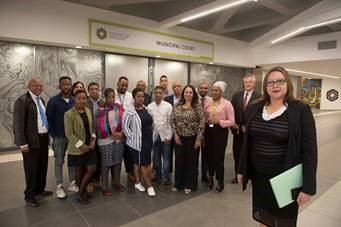
© City of Cape Town
Of the 154 000 cases, 85% of the cases handled at this court are related to traffic infringements and the remaining 15% relates to by-law cases as well as national and provincial legislation that the municipality is mandated to enforce. This includes transgressions related to planning, health, national building regulations, business licences and noise control regulations.

© City of Cape Town
On a daily basis the municipal courts also deal with the enforcement of by-laws related to graffiti, informal trading, nuisances, community fire safety, air quality, animals and environmental health. Recently, and of great importance, has been the enforcement and prosecution of water wasters in terms of the Water By-Law during this period of severe drought.
‘The City of Cape Town has been the pioneer in establishing and managing municipal courts, setting the bar quite high in terms of being the benchmark for best practice. The Cape Town Municipal Court, previously located in the City Hall, had to be relocated to the Strand Street Concourse due to space constraints. It was a challenge to deal with matters such as arrests due to a lack of holding cells. The court boasts a holding cell in its new location but transgressors are forewarned that this is not a five-star establishment and are advised to please stay on the right-side of the law,’ said the City’s Mayoral Committee Member for Corporate Services, Councillor Raelene Arendse.
The City entered into a Memorandum of Understanding (MOU) with the Department of Justice, the Director of Public Prosecutions (DPP) and other stakeholders to establish the first municipal court on 18 April 2000. Although the City is responsible for the day-to-day management of the municipal courts, prosecutions are carried out under delegation by the DPP and the prosecutors are bound by the code of conduct of the DPP.

© City of Cape Town
Working together with key partners to improve service delivery to residents is one of the priorities in the City’s Organisational Development and Transformation Plan (ODTP) that was adopted by Council last year. The ODTP is helping to transform the City into a more customer-centric organisation.
End
Published by: